
Animal Feed Machinery: From Mixing Requirements to a Working Line
MUSA BOD GROUP · PRACTICAL BUSINESS GUIDE
Feed machinery should follow a professionally developed product specification. A machine supplier can describe equipment, but that does not replace qualified animal-nutrition advice. Define the intended species, feed form and ingredient characteristics before choosing grinding, mixing, pelleting or packing equipment.
Develop the product before the machine list
Ask a qualified nutritionist to establish the formulation and the quality controls appropriate to the intended animals. Identify ingredient supply, seasonal variation and testing needs. Equipment cannot correct a fundamentally unsuitable formulation or contaminated ingredient. Keep supplier machinery claims separate from claims about animal performance; the latter require appropriate evidence and professional oversight.
Control weighing and ingredient handling
Small inclusion ingredients and major ingredients may need different weighing arrangements. Decide how batches are identified, checked and recorded. Poor measurement can undermine a well-designed mixing process. Consider receiving, storage, grinding where required, controlled addition and transfer without losing traceability. Ask how the equipment handles bridging, moisture variation and changes in ingredient bulk density.
Evaluate mixing rather than only batch size
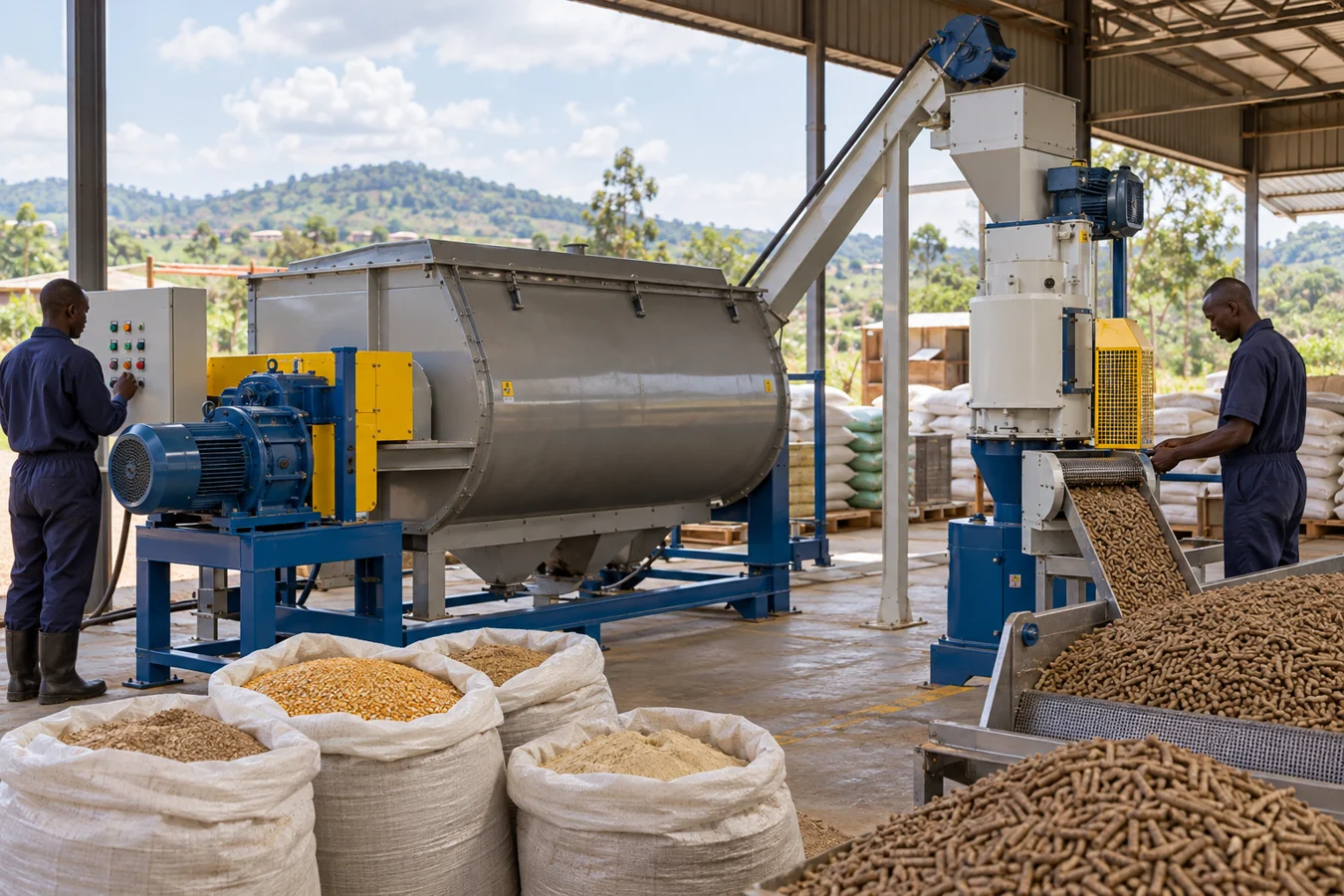
A mixer volume is not enough to establish useful output. Ask for the working fill range, mixing and discharge times, and the method used to assess uniformity. Samples should represent the batch, including relevant discharge points. Consider carryover between products and how the mixer is cleaned. Where a particular ingredient creates a significant hazard, obtain specialist guidance on separation and validation.
Treat pelleting as an additional process
A pellet mill may require associated conditioning, cooling, screening and other equipment depending on the product and machine design. Ask which systems are included and how heat and moisture are managed. A pellet emerging from a die is not the same as a stable product ready for bagging. Confirm how final quality, breakage, cooling and storage will be checked in a representative run.
Design for safe operation and maintenance
Grinding and feed handling can create dust and expose moving parts. Appropriate specialists should assess guarding, dust controls, safe access and electrical arrangements. Obtain operating procedures, isolation instructions and training. Ask which screens, hammers, bearings or dies are consumable items for the proposed configuration, and include a realistic spare-parts plan rather than depending on emergency imports.
A practical example
Illustrative planning example: a one-tonne batch mixer may not deliver one tonne every few minutes once ingredient weighing, loading, mixing, discharge and changeover are included. Build the daily schedule from the complete batch cycle.
Prepare your enquiry
- Qualified formulation and ingredient quality plan
- Weighing, traceability and batch records
- Mixing uniformity test and cleaning method
- Complete pelleting and cooling scope if required
- Guarding, dust control and spare parts
How Musa Bod Group can help
Bring your project brief to Musa Bod Group for machinery sourcing discussions, business advisory or coordination with relevant technical partners. We agree the scope, responsibilities and fees before engagement. Equipment availability, performance, delivery, warranty and after-sales arrangements are confirmed for the specific supplier proposal. This guide supports planning; specialist designs, safety procedures, food-process validation and legal or financial decisions require the appropriate qualified professionals.
Request a consultation · Explore machinery support
Continue reading
- Fruit Processing Equipment: Planning Juice, Pulp and Preserves
- Factory Layout Planning: Design the Flow Before Buying Equipment
Further reading
FAO: equipment selection and maintenance. External references provide background; historical manuals do not establish current Uganda regulatory requirements. Where an international safety reference is used, it is not presented as Ugandan law.