
How to Choose Maize Milling Machinery in Uganda
MUSA BOD GROUP · PRACTICAL BUSINESS GUIDE
A maize mill should be selected around the flour you intend to sell, the grain you can reliably obtain and the customers you can reach. A large motor or impressive demonstration does not, by itself, establish whether a milling business will work. Begin by writing a production brief that connects the raw maize, each processing stage and the finished product.
Define the flour and the customer
Decide whether you will sell wholemeal flour, a more refined product, or a milling service in which customers bring their own grain. These models require different handling, payment and quality arrangements. Speak to prospective buyers about pack size, texture, consistency and delivery frequency. Record the agreed product specification before requesting a machine quotation; a supplier cannot meaningfully size a line around the word “flour” alone.
Map the complete process
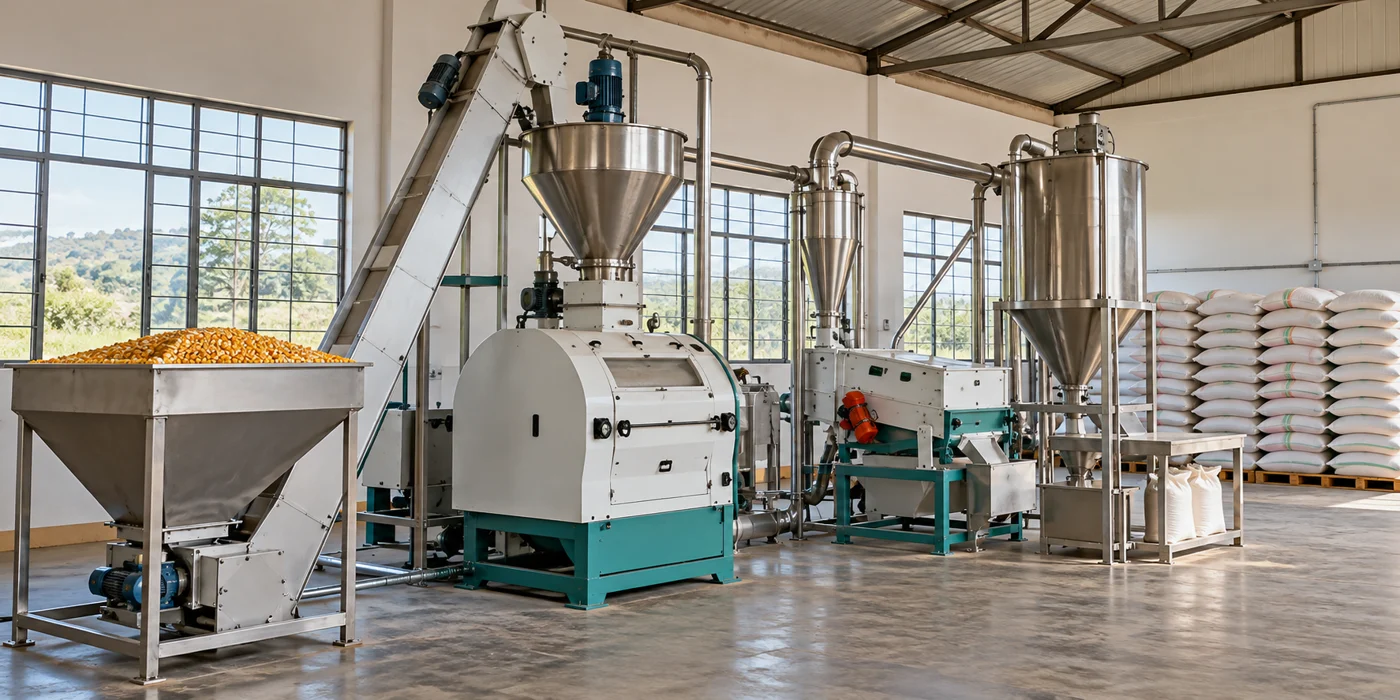
List receiving, cleaning, any required conditioning or dehulling, milling, sifting, weighing and packing. The exact sequence must be designed for the intended product. Buying a mill without considering grain cleaning can leave contamination and maintenance problems unresolved. Equally, a fast mill connected to a slow sifter will not achieve the advertised milling output as saleable packed flour. Ask the supplier to identify the expected bottleneck and the basis of every capacity claim.
Separate input capacity from saleable output
Ask whether a capacity figure refers to maize entering the machine or acceptable flour leaving the complete line. Establish the assumptions about grain condition, screen size, operating hours and product quality. Request a test using representative maize, with weights recorded for input, flour, by-products and rejects. A test should demonstrate repeatability and product quality, rather than only showing that the motor runs.
Check the building and the support arrangements
Confirm the electrical supply, motor starting requirements, machine dimensions, foundation needs and safe maintenance access with appropriate specialists. Plan separate routes for grain delivery and finished flour dispatch. Ask who supplies wear parts, who performs repairs, how long parts typically take to arrive and what the written warranty excludes. Include operator training and manuals in the quotation so the handover does not end at delivery.
Compare complete operating proposals
Compare the machine price alongside installation, electrical work, dust management, packaging, staff time and maintenance. Record the assumptions behind any proposed production budget. It is usually more useful to compare the cost of producing an acceptable kilogram at realistic utilisation than to compare purchase prices alone. Do not treat a supplier’s suggested selling price or sales volume as confirmed local demand.
A practical example
Illustrative planning example: a machine advertised for 500 kg of grain per hour does not automatically produce 500 kg of packaged flour per hour. Cleaning losses, the selected flour specification, stoppages and packing capacity all affect the result. Agree a measured acceptance test for the complete process.
Prepare your enquiry
- Finished flour specification and target buyers
- Representative grain sample and test procedure
- Complete line capacity and product recovery
- Power, foundation, cleaning and maintenance access
- Written delivery, training, spares and warranty scope
How Musa Bod Group can help
Bring your project brief to Musa Bod Group for machinery sourcing discussions, business advisory or coordination with relevant technical partners. We agree the scope, responsibilities and fees before engagement. Equipment availability, performance, delivery, warranty and after-sales arrangements are confirmed for the specific supplier proposal. This guide supports planning; specialist designs, safety procedures, food-process validation and legal or financial decisions require the appropriate qualified professionals.
Request a consultation · Explore machinery support
Continue reading
- Grain Dryers in Uganda: Choosing a System for Your Harvest
- Fruit Processing Equipment: Planning Juice, Pulp and Preserves
Further reading
UNIDO cereal milling technology manual. External references provide background; historical manuals do not establish current Uganda regulatory requirements. Where an international safety reference is used, it is not presented as Ugandan law.